

The Alignment Paradox

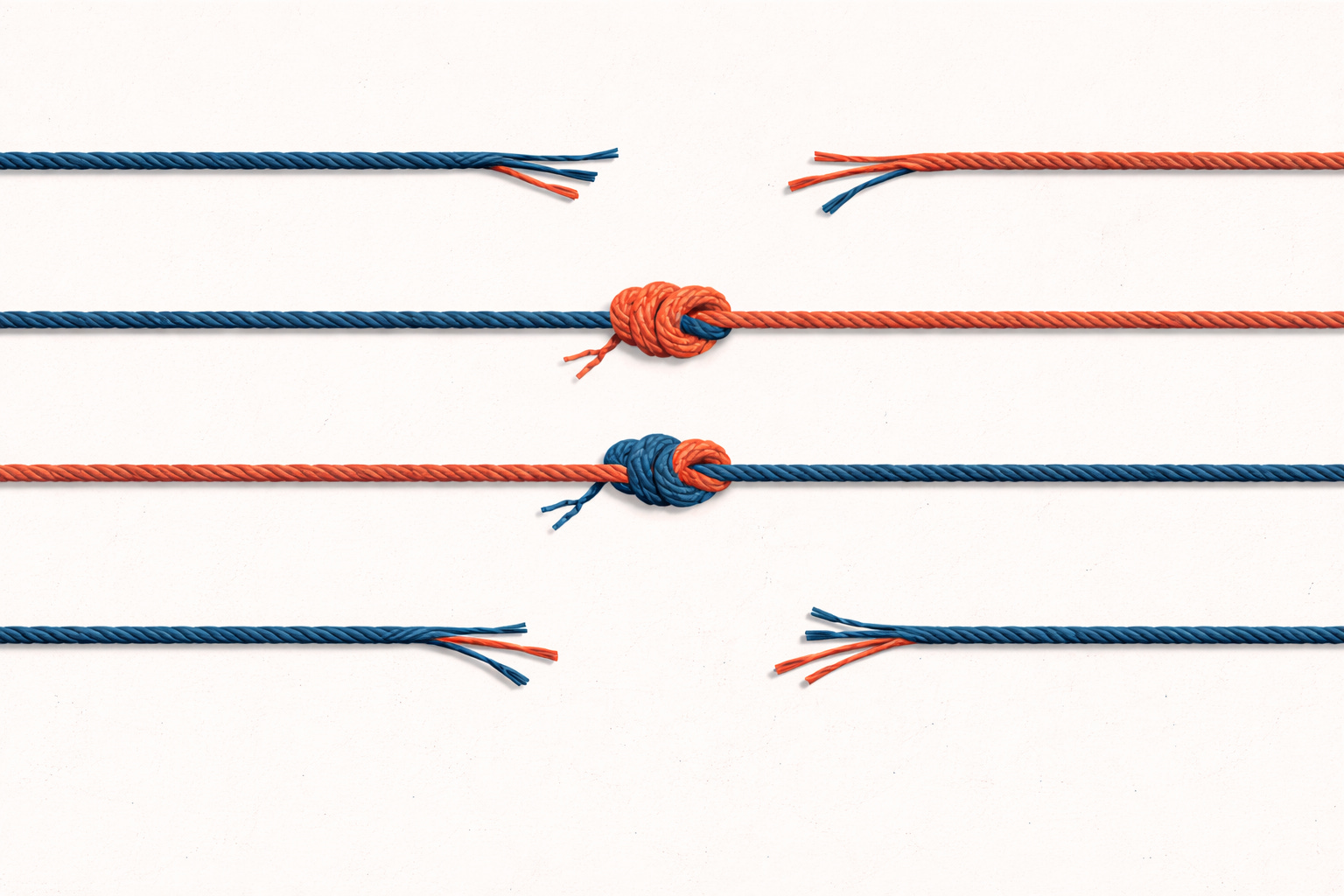
Across more than 50 interviews with CEOs, Chiefs of Staff, and senior leaders, one pattern surfaced again and again: strategic alignment is highly valued, yet consistently fragile.
Leaders talk about it confidently. They invest in it and expect it. Most are surprised by how quickly it can weaken in practice.
Strategic alignment matters because it underpins performance, reduces friction, improves engagement, supports growth, and builds confidence and trust. Without it, even well-designed strategies fall short at execution. Yet despite this, alignment remains elusive in practice. In our 2018 research into strategic alignment and communication, 96 % of leaders said alignment was fundamental to achieving organisational goals. Only 13% believed their organisations were highly aligned.
Seven years later, you might expect that gap to have narrowed. It hasn’t.
Recent research by Saïd Business School’s Jonathan Trevor reached almost identical numbers, despite being conducted in a very different context. Different organisations. Different pressures. Seven years apart.
The same paradox.
Alignment is universally valued. Yet poorly understood, unevenly practised, and difficult to sustain.
That’s the Alignment Paradox.
What makes this paradox harder to ignore is that leaders themselves don’t express strong confidence in alignment today. Research from Axios HQ found that only 27% of leaders believe employees are entirely aligned with organisational goals. That is already a low bar. Only 9% of employees agreed.
This gap between belief and lived experience came through clearly in our interviews.
“Leaders would say it’s really important, but they’re not necessarily willing to do the work to create it. They say all the right things, but their behaviour doesn’t match.” ~ Jenni Field, Leadership Credibility and Organisational Communication Expert
“It’s the leadership team’s responsibility to be aligned. If they’re not, employees will see it immediately. In one company, only one leader could name three of four strategic priorities – the rest couldn’t name any.” ~Jeppe Vilstrup Hansgaard, CEO & Change Leadership Advisor, Innovisor
Leaders sense misalignment and still misread it
One of the most revealing patterns in our research was described by Katie Macauley, Managing Director of AB, as “Glass Head Syndrome.”
Leaders live inside the strategy. They helped shape it, debate it, and refine it. Over time, that proximity creates an assumption that others can see what they see. The logic feels obvious. The intent feels clear. Silence is taken as understanding.
Yet silence often masks something else entirely.
This isn’t wilful blindness. It’s a very human dynamic. When pace is high and expectations are relentless, people default to nodding rather than questioning. Agreement gets confused with alignment. The absence of pushback is mistaken for buy-in.
“Leaders also need the humility and awareness to understand that what’s going on in their world is not necessarily what’s understood by everyone else, and that’s not because others are ignorant, careless, or uninterested.” ~ Jane Mitchell FRSA, Independent Consultant and NED, JL&M Ltd
Over time, this can slide into apathy – particularly when people speak up and nothing changes, or when past input hasn’t been acted on.
Strategy exists, but alignment dissolves in translation
Many organisations do have a strategy (some don’t). They have a purpose (some don’t). They have organisational priorities. And yet alignment still fades.
As strategy moves through the organisation, people interpret it through their own biases, mental models, experiences, and cultural lenses. What feels clear at the top can feel abstract or disconnected further out. Ownership becomes diffuse and accountability blurs.
“They’ll all say alignment is a priority. But when you ask what it means, you get completely different answers. It’s like everyone’s looking through a different lens.” ~ Simon Cavendish, SCMP, Internal and Change Communications Consultant
Our research showed that alignment is often assumed to be strongest at the top – though that isn’t always the case. What is consistent is that fractures tend to emerge as strategy moves beyond the exec team and into the organisation. Jeppe Vilstrup Hansgaard’s work with many leaders on change and transformation shows this decay curve:
“Most organisations are good at creating the strategy – it’s on paper and on posters. But 80% of leaders have forgotten it after three months, just as employees have started to learn about it.”
Alignment doesn’t fail because leaders lack intent. It weakens when shared clarity, ownership, and accountability diverge, and commitment isn’t strong enough to hold them together. When that happens, effort increases but traction declines.
Where alignment is tested most severely: behaviour under pressure
The Alignment Paradox doesn’t exist because leaders don’t care. It exists because alignment depends on behaviour under pressure.
Volatility, speed, and constant demand change how leaders operate. Decisions accelerate. Competing priorities multiply. Focus fragments. Choices between one good and another become conflicted. Reflection gives way to reaction.
“Leaders stand like a deer in the headlights – there’s so much going on that they freeze instead of deciding and moving forward.” ~ Jeppe Vilstrup Hansgaard
In these conditions, difficult conversations get deferred. Tensions remain unspoken, and assumptions go untested. Over time, this creates what we think of as conversation debt – the accumulated cost of conversations that should have happened but didn’t – a risk that is increasingly recognised in leadership research.
Like misalignment, this debt isn’t loud. It compounds quietly. Alignment erodes long before anyone names it as a problem. By the time it shows up, leaders are often dealing with second-order symptoms such as slower decision-making, a lack of accountability, and missed opportunities, rather than the real cause.
Alignment demands humility, vulnerability and sustained commitment. It requires leaders (and their teams) to slow down, invite challenge, and stay open to perspectives that complicate the narrative.
However, ego, fear, hubris, and speed push in the opposite direction. As Jeroen Kraaijenbrink, Co-Founder of Strategy Inc, observed:
“The biggest barrier is mental – old beliefs about how organisations work. Most of the field of strategy is stuck in those dogmas… Ego and fear are two sides of the same coin: the fear to let go, the fear that others turn out to be more intelligent than you.”
Why the paradox is intensifying now
These dynamics aren’t new, but they are becoming more consequential.
Strategy cycles are shorter. The context leaders operate in is more complex. Decisions are made faster, with less time for shared sensemaking, while expectations of alignment remain high. AI is accelerating workflow and decision-making, while increasing uncertainty.
In this environment, misalignment is more likely.
Acceleration doesn’t create the Alignment Paradox. It exposes it and raises the cost of assuming alignment rather than deliberately building it.
Holding the tension
Alignment is a discipline, a process, and a capability – for leaders and teams.
Our research shows it relies on shared clarity, ownership, accountability, and sustained commitment. Without commitment, alignment shows up in moments and disappears when it’s tested.
The paradox persists because this work is demanding, ongoing, and deeply human. It can’t be solved with a strategy deck, a town hall, talking points, or a well-run campaign. It requires leaders to notice when alignment is fading and to intervene early – through focus, curiosity, dialogue, and courage.
For now, it’s worth sitting with the paradox itself, and considering:
If alignment matters, and we know it’s weak, what happens when leaders refuse to stay in the tension between the two?
About our Clear Leaders work
This article is part of a series exploring new perspectives on strategic alignment and leadership, based on our third global research study.
The research is led by Zora Artis and Wayne Aspland and draws on interviews with more than 50 CEOs, Chiefs of Staff, and senior leaders across communication, HR, strategy, and operations.
We’ll be sharing further insights ahead of the full white paper release later in February, alongside the launch of Clear Leaders. To receive early access, sign up here.
Great article. For me, the biggest challenge is the gap between developing a strategy and embedding it in the organization. Many companies invest significant time, effort and resources in creating strong strategies but spend far less on communicating them, explaining them and making them part of everyday work. Too often, it becomes a top-down exercise with little room for discussion, which leads to low engagement and makes the strategy feel like a tick-box task rather than something everyone can live and breathe every day.
Powerful research by the way!